Friday, September 23, 2011

Wild Hog Bursts Into Local Whataburger

I’m still laughing over this newspaper report from my little bitty home town in Texas (pop. 1,900)


It seems that a large, wild pig escaped from a trailer while being transported, bashed through the front glass doors at a local restaurant, frightening the staff and patrons. It finally ran behind the counter, a worker opened the back door and it ran out.

Now, you might think that livestock wreaking havoc in public places might be an isolated event in my home town, but you’d be wrong. Very wrong.

In May of 1976, my home town was conducting a Bicentennial celebration, part of which was to acknowledge the local longhorn cattle industry in the area. So, the town officials decided it would be a good idea to march about a hundred head of longhorn cows through the town square to commemorate its heritage.

Here came the longhorns into the town square, herded by real, live cowboys. The announcer heralded their arrival over the loudspeaker which, if you know anything about cows, caused instant terror among them.

Apparently, cows hate loudspeakers and they began a stampede around the town square. The cowboys and townspeople scattered everywhere, fleeing the onslaught of longhorns which had been our heritage for the past two centuries.

I was not there for some reason. I was home alone, but my mother, brother and grandmother were there and remember it well. The Stampede became an annual event in my hometown after that, only without any cows.

Here’s a photo from the local paper:


About 30 miles up the road is the small town where my dad and stepmother have lived for 40 years. That town’s heritage is turkey farming (not longhorns.) Back in the turkey heyday, the turkey farmers found that the best way to get thousands of turkeys to the market was to simply herd them down main street.

I’m not kidding! Here’s a photo of it:


So, that event became the annual Turkey Trot. I remember marching with my high school band in the Turkey Trot every year.

So, you can imagine my laughter upon hearing that a giant, wild pig burst through the front doors of a local burger joint.

That was just typical life in my neck of the woods.


Labels: , , ,

Wednesday, July 06, 2011

Little Bitty Home Town

While in Texas, I took a drive to visit my Little Bitty Home Town, pop. 1,900. It sure brought back some fond memories.

My grandparents owned the local dry-cleaning store and I worked there beginning at age 11. It was un-air conditioned. Seeing that the front doors were open, it looks like it still is:


During high school, I worked at the local bank part time. My little un-air conditioned office was up on the second floor in the corner.


I spent many an hour up there, posting checks to people's accounts. Nary a computer in sight. It was all done manually.

Here's the house where we lived:

Now for a really fun memory. . . When I was really little, my grandmother used to take my brother and me down to the edge of the San Antonio River. It was a place where a bridge used to be and had long been washed away. However, by the time I was about eight or nine years old, the little road that went down to the river had become grown over with trees and brush and was no longer accessible.

But now, it's been cleared away and there's a sidewalk down to the same spot on the river we used to go to. (The sidewalk is to let canoe travelers access the river)

I scurried down there - - and there it was! The same exact spot my grandmother used to take me as a child. The stumps from the old bridge were still there.

The thing was, I used to think that this river was SO deep and swift and frightening. My goodness, one can easily wade across it.

But here it is. You can almost hear the laughter of my grandmother and two little boys:

Labels: ,

Tuesday, September 22, 2009

Lunch During the Wonder Years

I’m not that old. Really.

But life in my little-bitty hometown in Texas was really behind the times, so to speak. The everyday surroundings and lifestyle that I was accustomed to in the 60s and 70s was really equivalent to that of, maybe, the 40s or 50s.

Case in point.

I was in the sixth grade in 1971. Junior High, for crying out loud. We had an “open campus” back then which meant we could go anywhere we wanted for lunch, provided we were back by the time the bell rang. One could walk home if you wanted, eat in the cafeteria with the nerds, or bring your lunch and eat outside or even down the street.

Or better yet, you could eat downtown.
(Cue the Petula Clark soundtrack here)

The town square was only about five blocks away and, if you ran really fast, there was just barely enough time to eat at one of the lunch counters and, if you ran back really fast, make it back to school in time for the bell.

But just barely. Such an intense endeavor was horribly exciting for an 11 year-old. But off we would go, running down to the square as fast as we could go.

Here’s a picture of downtown in my little-bitty home town.
Raymond’s Café had a very economical hot roast beef sandwich that we liked. You’d get a few slices of roast beef on Texas toast, topped with brown gravy and a side of mashed potatoes for the everyday low price of . . .

. . . are you ready for this?

Sixty-five cents. (.68 with the tax)

We would tear into Raymond’s, plop down on the spinning stools (spinning around like a whirling dervish, of course) wolf down our hot roast beef and gravy, plunk down the 68 cents, and run as fast as humanly possible back to school. (If you were late, the privilege of “open campus” was revoked for about a month, so you didn’t dare be late. Ever.)

There was not a minute to spare – certainly no opportunity for getting into trouble. I’m sure the school officials planned it that way.

I doubt that any Jr. High schools allow open campus anymore, not that it matters.

After all, it’s really impractical to run five blocks and spin at a lunch-counter while texting "OMG WHERE U AT" the whole time.

Labels: ,

Wednesday, July 22, 2009

Delivery

The other day, the temperature had climbed above 80 degrees which made it much too hot to walk the requisite five blocks to the grocery store. I just don’t “do” hot weather. So, I hopped online to Peapod, our nifty grocery delivery service and began filling out my order.

Peapod is really great. They have everything. A jicama? It’s there. Organic game hens? Just click on their little bodies and they’ll be delivered.

Although the prices are a little, well, pricey, the delivery charges are pretty nominal. You just select a two-hour window when you want your delivery and it’ll be there.

As I was clicking things into my virtual shopping cart, I thought about my grandmother (“Budgie”) in my little bitty home town. Budgie would have just loved Peapod.

The thing is, we had a wonderful grocery delivery service in my little bitty home town. We only had one grocery store but they would deliver and Budgie often took advantage of that.

She was not a lazy woman by any means. It’s just that she was such an extrovert and loved people so much – grocery shopping would only take up valuable time that she could have been spending with her friends.

We could phone up the grocery store by dialing “201” (you only had to dial three numbers for a local call) and Budgie would place her order.

She would request a “Sunday roast” and the butcher would know that it meant a large shoulder cut. If she ordered a watermelon, they would place it in the cooler ahead of time because they knew she liked them cold. (Budgie and I adored watermelon.)

Off she would go, looking in on friends, on elderly people that needed looking in on, and the groceries would arrive.

The thing is, it didn’t matter if no one was home. They would come in the back door, leave the groceries in a box on the counter and even put the cold items in the fridge and the frozen things in the freezer.

She had a “yard man”, an elderly fellow named Ham-Bone, and if he was around he would accept the delivery. But Ham-Bone’s presence was not required.

Everyone had a charge account at the grocery store. If I was sent on my bike to procure a loaf of bread, I could just tell the clerk to charge it to Budgie’s account. Once a month or so, she’d stop by and pay the bill.

Forty years later, I’m sitting at the computer filling out my order. I glanced at Budgie’s note pad on my desk - - the one she got from the grocery store and had by her telephone for decades.
I still have it.


I’d have to click on just the right item or else I might end up with Soy Moo instead of Silk soy milk. The Peapod people won’t know automatically what I really would have wanted.

I’d have to be home during the two-hour time slot for they surely won’t leave it with the security guard if I’m not there. He’s certainly no Ham-Bone.

I wanted a watermelon so I clicked on that.

$8.99 for a little watermelon?? Are you kidding me??

(Budgie would have flipped out over that)

I may not like hot weather, but I’m cheap.

I got my lazy butt to the store.

Labels: , ,

Monday, November 17, 2008

Banking

The other day, I looked at my checking account online and got a cold chill up my spine.

No, it wasn’t because of the balance.

I was able to click on a check I had written and see a copy of that check.
Instantaneously.

That made me realize how much banking has changed since I had my first job in a bank.

During my senior year in high school, I took a class in “Office Education” which, aside from drinking beer before every half-time marching show, turned out to be the most productive activity during my high school career.

The best part about Office Education was that I actually got to work in the local bank (First National Bank) for half the school day.

The best part about working for half the school day was that I never had to take trigonometry.

Anyway, I worked in the checking account department in the little bitty bank in my little bitty home town. Mind you, this was 1977 and, although many banking operations were computerized back then, there was not one iota of computerized anything in the bank where I worked.

Everything was all done manually.

Actually, we took sticks and rocks in and out of the vault to indicate how much money each person had in their account.

Well, practically.

Each day, one woman would take all the checks and deposits from the tellers and use a big, clunky machine to verify that they were equal.

Then, several of us would put all the checks in alphabetical order by hand. This was back in the day when many of the checks were “counter checks” - - just blank checks that everyone in town used - - no names printed on them, no account numbers.

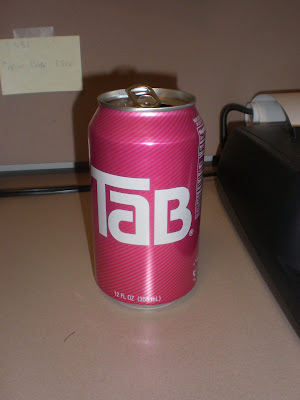
Then, I would take all the checks to another big, clunky machine and begin “posting” them to everyone’s account. Always, with a can of Tab diet soda by my side. (To this day, I love Tab and it reminds me of working at the bank in high school).

I would take your actual bank statement (we had just switched from using papyrus) carry the balance forward, subtract the checks, add the deposits, and the machine would type in a new balance - - - automatically!

If an account didn’t have enough money, we'd hit it with a whopping overdraft fee of - - are you ready for this? - - -two dollars and fifty cents.

There was no such thing as a “bounced check.” We would just carry your balance in the negative and eventually, Mr. Dohmann from the bank would call you on the phone.

Since many of the checks weren’t personalized or had account numbers on them, we’d often have to use intuition to figure out which account to take it from.

For example, if Mr. Henderson wrote a check to the feed store, we would just know to debit his “farm account” rather than his joint account with his wife.

At the end of the day, all the checks and deposits that I posted had to balance with the lady’s totals from the first big, clunky machine.

My totals never balanced.

So, I had to go through all of my postings and find out where I made a mistake. I learned a lot about how to find errors.

For example, if my “outage” was divisible by nine, that meant that I had transposed a number somewhere.

Really. Take the number 4167. Transpose it to 7614. The difference is 3447 which can be divided equally by nine - - - 383.

A more simple one. 69 transposed to 96. The difference is 27 which, divided by 9 is 3.

See? That's a lot more useful to know than trigonometry.

After all the checks were posted, I’d file them in each account-holder’s little file which contained the signature card. As we put each check in the file, we’d compare the signature on the check to the card. - - After all, anyone could write a check on any account simply by signing it.

However, we pretty much had everyone’s signature memorized.

For example, one time my cousin wrote himself a thirty-dollar check on my grandmother’s account (which I caught while filing the checks) and oh boy, did he get in trouble!

At the end of the month, we’d fold up everyone’s statement, plunk in the cancelled checks, stuff it in an envelope and mail it to them.

That is, unless they just wanted to pick up their statement at the bank (we automatically knew who wanted to) and we’d leave their statement with the teller.

So, you can see why I was pretty amazed when I could instantly look at my cancelled check online the other day.

Banking has certainly come a long way during my lifetime.

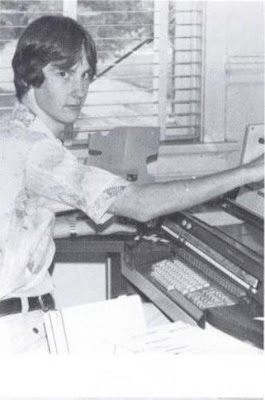
Oh, and here’s a photo from my senior yearbook. That's moi, posting checks at the bank on the big, clunky machine.


And look what's on my desk right now

Labels: ,

Saturday, July 19, 2008

The Harbor Bridge

When I was a little bitty kid growing up in my little bitty home town in south Texas, my grandparents would often take me and my little bittier brother to spend weekends in the Big City.

Usually, a weekend in the Big City meant San Antonio which had been my grandparents’ home town. However, during fishing season, my grandfather’s concept of the Big City meant “Corpus”.

Corpus Christi, Texas, that is.

My little bitty home town of Goliad was equidistant between Corpus Christi and San Antonio, about eighty miles from each. But to my little mind, San Antonio seemed more like The City than Corpus.

To this day, whenever I hear Petula Clark’s 1965 hit Downtown, I picture the tall, brown buildings lining the inner city streets of San Antonio.

But ever so often, my grandfather would take us to spend a weekend in “Corpus.” Rather than heading north, we’d head southwest along the Gulf Coast plains of south Texas.

The flat roads would be endlessly lined with this grain crop called “maize”. I know that “maize” is somewhat related to the Native American word for “corn” but this was an entirely different grain.

To this day, I still have absolutely no idea what the South Texas grain crop of “maize” really is. I think it might be fed to cows or turkeys or oysters.
I don't know.

I just know that, as a kid, we’d just watch endless rows of it pass by the car window on the way to Corpus. Ever so often, there would be one stalk of it sticking above all the rest.

Boom. There’d be one stalk shooting above the rest among miles of evenly-grown heads of “maize.”

I asked my grandfather how that happened. He laughed and explained to me and my brother that when those seeds were planted, a seagull happened to fly by and shit on that spot, thus fertilizing that seed more than the rest. And that’s why those stalks were higher than the rest.

Sounded plausible to me. He was a good grandfather.

He also said that if my brother and I didn’t quiet down, he’d pull over at the next mailbox and just mail us home. Of course, when he’d see the next mailbox along the two-lane highway, he’d dramatically pull the car over and we’d both squeal with laughter.

He was a good grandfather.

He also said that if we were really good, he’d stop at the next town and buy us an ice cream cone. He’d give me the road map and have me look for the next sizable town that would have ice cream.

Okay, take a look at a map. There’s absolutely nothing between Goliad and Corpus Christi, Texas, but he had me honing some good cartography skills the entire way. I was almost seven years old.

He was a really good grandfather.

Anyway, the highlight of the trip was crossing the Harbor Bridge into Corpus Christi. My gosh, how I loved crossing that bridge.

Apparently, the only way to drive into Corpus prior to 1960 was over a drawbridge. As we came within 30 miles of the city, my grandfather would start telling us how traffic used to be backed up because of the drawbridge; how he’d practically have to wait for days to get into the city prior to this incredible, huge, colossal, Harbor Bridge being built.

Then, as we would begin the ascent to the bridge, he’d explain to me how the construction crews began building the bridge on both sides and

(we’d begin climbing the ascent higher and higher)

and the bridge construction reached across the water

(we would be among the steel trusses way above the bay)

And finally! Both sides met!

(And we’d reach the apex and begin our descent into downtown Corpus Christi)

God! How I loved that bridge! My grandfather made it so exciting.

We’d check into a nice hotel by the waterfront and my grandmother would continually slather my brother and me with Sea-n-Ski so that we wouldn’t get sunburned.

We'd go to a really nice seafood restaurant and I'd get to order a half-dozen fried oysters. The salad was a huge wedge of iceberg lettuce with this really strange dressing slathered over it (I think it was "Thousand Island")

I was only six years old, but I remember so well just wanting to stay in the air-conditioned hotel room where I could peer out the bay windows in the hotel room and watch the cars traverse the Harbor Bridge. . . .

. . . Are you ready for this?

Progress moves on . . . Ships are being built bigger and taller. . . . And apparently the Harbor Bridge isn’t tall enough anymore.

A new, taller bridge has been planned to replace the Harbor Bridge into Corpus. Can you believe it?

It seems just like yesterday that my grandfather was getting me to marvel at the big, new bridge. But "yesterday" has somehow slipped into four decades.

If I had kids, I’d love to show them the new bridge into Corpus. I’d tell them how the old bridge only came up so far, then crossed the channel and went back down. And how it had only six lanes of traffic. And how the old bridge was so incredible for its time and how my grandfather loved this bridge . . .

. . . But, of course, my kids would be in the back seat, ignoring the bridge and playing with their game-pods.

But on the way out of Corpus, I'd point out the fields of "maize". And I’d be sure to tell them how the seagulls pooped on that one maize seed to make it taller than all the rest. . .

. . then a quick pullover to a mailbox with an anecdote about their great-grandfather,

And, I'll just bet that a few squeals of laughter might be heard after all.

Labels: , ,